
JANUARY/FEBRUARY 2026
Dear Friends of Carmel,
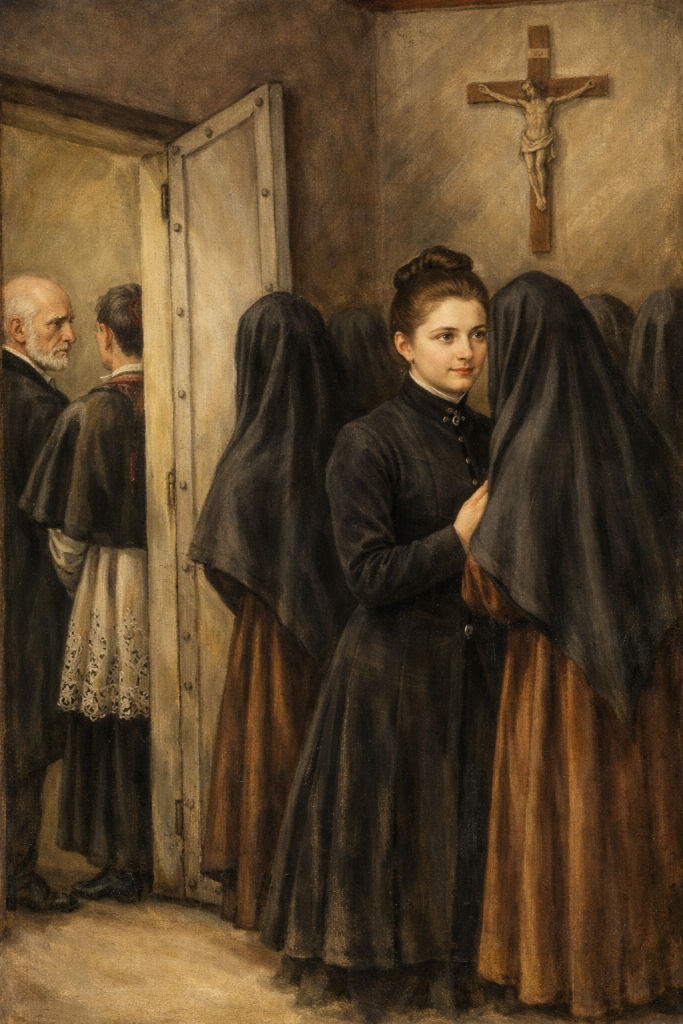
The last meal with the extended family, the leave-taking of the family home, the Mass at Carmel before her entry, when all her family wept… it was all heartrending to Therese, but she herself did not cry. She had shed so many tears in her efforts to enter Carmel! Now that the moment had come, she showed no outward signs of emotion, but her heart was beating violently as she approached the enclosure door. She embraced each dear one and finally her father; then she knelt for his blessing. He knelt too, blessing her “with tears flowing down his cheeks.”
The Carmelites, with their lowered veils, were waiting for her at the enclosure door. She crossed the threshold and entered the land of Carmel. M. Delatroette had blessed her at the enclosure door. However, not being reconciled with the entry of Mlle. Martin, he had some words of sarcasm and a reproachful warning for the Community. It was all lost on Therese, since she experienced “a peace so sweet, so deep,” it was impossible to express it. After being embraced by the Mothers and Sisters, Mother Marie de Gonzague took her to the choir where the Blessed Sacrament was Exposed, then it was on to her cell. “I felt as though I was transported into a desert; our little cell, above all, filled me with joy. But the joy I was experiencing was calm… I was fully recompensed for all my trials. With deep joy I repeated those words: ‘I am here for ever and ever!’” “This happiness was not passing. Illusions? God gave me the grace not to have a single one… I found religious life exactly as I had imagined it; no sacrifice astonished me.”
What was this Carmel and Community like? “Small and poor” was how Marie had described it when she entered in 1884. There were the red brick cloisters, a small garden, a small area for growing hay, and the chestnut “alley.” About to celebrate its 50th anniversary, it was not a big property. There were twenty-six nuns in the community, including the two extern sisters. The average age was forty-seven. Mother Genevieve, one of the two foundresses, was still living. She was then 81, and had been ill for four years. Sr. St. Joseph was even older, the eldest of the community. The Sub-Prioress, Sr. Febronie of the Holy Infancy, was also elderly. There were other sisters in their sixties. Mother Marie de Gonzague, the Prioress, was fifty-four. She had shown much interest in Therese and had fought for her entry. The community had five LaySisters – called Sisters of the white veil – who did the greater part of the manual labor, and did not recite the Divine Office.1 The Mistress of Novices, Sister Marie of the Angels, was forty-three. Sr. Marie of the Sacred Heart, who was twenty-eight and still in the novitiate, was assigned to be Therese’s Angel. Sr. Marie Philomene, forty-eight, was “very holy and very limited.” Finally, the last one in the novitiate was Sr. Marthe of Jesus, twenty-three, an orphan, who had been a white-veil postulant for three months, “a poor, little, unintelligent Sister” according to Mother Agnes.
St. Therese tells us that when she entered Carmel, “…suffering opened its arms to me and I threw myself into them with love.” It is necessary to take a deep look at this statement. First of all, what does it really tell us about St. Therese? It proclaims the deep faith of this fifteen-year-old. She recognized God’s will in the painful circumstances she met, and by throwing herself into them, we learn she surrendered herself to God in these things. That she did this “with love”, proclaims her love for God, Whom she saw and embraced. Secondly, we must examine the sources of this suffering to truly realize how virtuous and heroic this soul was from the start.
The first of these sufferings she met at the enclosure door. It was the presence of her two blood sisters: the then, Sr. Agnes of Jesus (Pauline), and Sr. Marie of the Sacred Heart (Marie). These would later be joined by Celine and her cousin and childhood playmate, Marie Guerin. The older sisters who had been her “little mothers” thought it was natural and even Providential that, following Therese’s entrance, their maternal rights and duties should be revived – on a higher plane, of course! Therese loved her family very much, and this never changed throughout her life, as her letters and notes to them prove, but she had always said she wanted to enter Carmel for Jesus alone and not to live a family life with her sisters. She had understood that Carmel was a desert, and, if Jesus called four sisters to it, His purpose was that each one should fulfill her vocation there as if she were alone. Therese had made her renunciation and was not minded to take it back bit by bit. Therefore, from the first day, with great gentleness but also with great determination, she sought to live as the Rule prescribed. Surely this was costly to human nature, both her sisters’ and her own. It would be the beginning of her martyrdom of heart…
As Therese’s Angel, Sr. Marie of the Sacred Heart was to familiarize her with the customs of Carmel and also how to follow the Divine Office. After about three weeks, Therese said to her one day: “It would be very nice to stay with you, but we are no longer at home.” As a postulant, she was assigned to help Sr. Agnes in the refectory. The Rule specified that there was to be no superfluous talk during work. Therese was absolutely faithful to this. To her “little mother” she could not say a personal word. Only during her final illness did she tell Mother Agnes: “How I suffered then, dear Mother; I could not open my heart to you, and it was as if you knew me no longer.” Later when Celine entered, Therese was her Assistant Mistress of Novices, but she treated her as she did the other novices. Later still, when Marie, her cousin, was assigned to work with her in the sacristy, Therese told her: “We must be very careful not to indulge in any useless talk.” It was very tempting for them to make up verses for everything, probably as they had done as children. Sr. Therese told her, “We must save it for recreation.”
Although on certain days the Rule permitted spiritual conversations between two nuns, Sr. Therese never requested this permission for herself. She did see her sisters at the common recreation twice a day, but it was rare that she found herself beside one of them. She would sit down by the Sister nearest to her, or by one who looked downcast or tired and in need of cheering up. For her sisters this was almost a demonstration of a lack of love. When Mother Agnes was ill, she petitioned her sister to come and see her. Sr. Therese gently replied, “Have other Sisters visited you? No? Then I must deny myself also.” Sr. Therese was in the habit of remarking to her sisters: “We must apologize to others for our being four under one roof.” She saw this “apology” was necessary because other Sisters found it hard that they had their family with them, and some were even jealous of this. Therefore, one reason for her not showing any particular love for her sisters was out of charity to the other Sisters. She wanted, like Jesus, to show them her love. Another reason was her desire to deny herself and thus to prove her love for her Spouse, to be faithful to Him in the least little thing, to always act under the influence of His inspiration.
Mother Agnes stated in the Epilogue of the first edition of “The Story of a Soul”: “We may also say that it was impossible to tell whether she loved her sisters more than any of the others.” An older Sister, who was not particularly fond of St. Therese, remarked: “I observed that her sister showered great attention upon her, but she herself was completely free from family ties.” Her writings show us that we should nuance what this Sister says by saying: St. Therese mortified herself to the point that her family ties could not be noticed. What must impress us is that she began this mortification when she was fifteen years old and it lasted until a point during her last illness when something made her alter her behavior to a certain extent.
We will continue looking at other sources of her suffering in the next issue.
XXXXXXXXXXXXXXXXXXXXXXXXXXXXXXXXX
On the feast of the great St. Francis de Sales, we received our Final Certificate of Occupancy, which was heralded by cheers at the noon recreation! Deo Gratias, indeed! Although this marks the end of the construction project, things are still very busy around here. The process of moving into the new wing is well underway. We are most grateful to all our friends and benefactors who have assisted us in completing this project debt-free (Yes! Our building fund can now close!) and in so many other ways as well – donating furniture and furnishings, assembling shelves, doing handyman installations, and much more. Sisters now occupy the new cells, ensuring that everyone, including our new postulant who joined us in November, has a proper cell. The offices are being set up gradually. Chapter has been held in the new Chapter Room since early January. The big parlor has a beautiful new iron grate, thanks to the hard work of the same generous benefactor who made the Choir grate many years ago. With all this, life continues as usual, and the garden plans have been drawn up, the first seedlings started, and other preparations begun. Post-construction projects are also well underway. We are still in the brainstorm stage of our project for a freestanding greenhouse, already paid for by generous benefactors, but needing careful planning as to location and type. Our existing old electrical systems are in need of being upgraded after 35 years, and work has begun on the exterior dependencies, where structural damage has added some urgency to the matter. (It always seems that nuns are miraculously spared from danger – angels holding up compromised walls and sagging roofs! Deo Gratias!) Several other projects are challenging the grey matter and occupying the time of our dedicated teams of helpers, to whom we are most grateful for their assistance in this intense phase of developing our Carmel monastery and property. We hope that 2026 will bring many blessings to all of those who have helped us so generously in our time of need. Be assured of our prayers for you as we look forward to the coming of Lent.
Yours in the Sorrowful & Immaculate Heart of Mary,
The Carmelites
1 Since moderniza on there is now no necessity of Lay Sisters; therefore, Pope Pius XII authorized their suppression.