
PAX CHRISTI!
MAY / JUNE 2025
Dear Friends of Carmel,
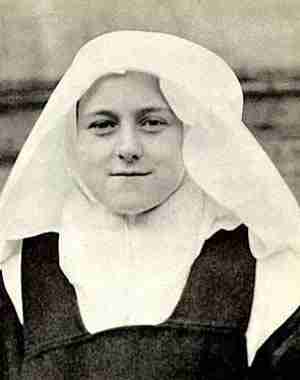
In the last issue, it was seen that St. Thérèse, at nine years old, was bearing up under stressful circumstances. Let us briefly recall and complete them here, in order to better understand the next cross given to her and her family.
Firstly, she was at a school where she was not happily adjusted, and to make it worse, some students bullied her. In spite of this, she was putting all her heart into getting the highest marks possible in order “to please Papa.” An extra-long delay was added to the reception of her greatly desired First Communion, but most keenly felt was the entry of Pauline into Carmel. Pauline had been the re-embodiment of her mother and had given her a sense of security after her mother’s death. Now Pauline was “lost to [her],” as she put it. Outwardly, she accepted this and all other sacrifices. She never spoke of any of it at home.
By December of the year Pauline left, Thérèse began to experience continual headaches, pain in her side and stomach, a rash, loss of appetite, and disturbed sleep. Without being chosen by Thérèse as her “third” mother, Marie assumed that role. By temperament, she was more strict than the sweet Pauline, and likely worried about Thérèse. She may have been a little severe with her. Thérèse, in her current state, “answered back,” and also had “little tiffs” with Céline… yet she continued her life as usual, and without complaint, until Easter of 1883 (March 25). Céline and Thérèse were staying with the Guérins, because Mr. Martin had taken Marie and Léonie to Paris for Holy Week.
On Easter evening, her uncle had taken Thérèse for a walk and was recalling memories of his sister (Thérèse’s mother) and life at Alençon. Thérèse burst into tears. Her aunt, judging her to be overtired, put her to bed instead of letting her go to a Catholic meeting with Mr. Guérin and the other girls. Thérèse began to tremble, feel cold, and grow agitated. Although her aunt did everything to warm her, the trembling lasted all night. In the morning, her uncle, greatly concerned, called the doctor. He had a ready answer, but was surprised to see someone so young suffering like this. Thérèse was a little over ten years old. She suffered from nervous trembling, seizures of fright, and hallucinations. She was in a very weak state and could not be left alone.
This has sometimes been referred to as “the mysterious malady of her childhood.” With all the theories put forth, it still remains obscure. Fr. Petitot thought the collapse was brought on by “various causes, among them excessive psychic tension.” St. Thérèse herself seemed to confirm this in her autobiography when she said:
“It is surprising to see how much my mind developed in the midst of suffering [Pauline being inaccessible]; it developed to such a degree that it wasn’t long before I became sick.”
Her sisters first accepted the doctor’s explanation but later felt there was something diabolical about it—because of the hallucinations and the fact that, if left alone, she would do a somersault from the bed onto the tile floor.
On April 6th, the day of Pauline’s Taking of the Habit, Thérèse—who had insisted she would go—was found well enough to visit her sister in the outside parlor before the ceremony, but was brought home immediately after. The next day, she suffered a serious relapse. Her poor father, not knowing what would become of her, eventually gave Marie gold pieces to have a Novena of Masses offered at Our Lady of Victories in Paris—the shrine so beloved by the Martin/Guérin family. A miracle was asked for, as they had no hope of a medical cure. The Virgin of the Smile, the statue before which the Martins always prayed, was moved into Thérèse’s sickroom.
It was on Pentecost Sunday, May 13th, during the Novena of Masses, that the miracle occurred. Léonie had been watching Thérèse while Marie had gone to the garden below. Thérèse began to call out “Mama, Mama,” softly at first, then louder and louder. She could not recognize Marie when she entered the room. Thérèse was very frightened and hallucinating. Marie tried to give her something to drink to help her recognize her. “You want to poison me!” Thérèse cried out. The sisters realized a crisis had come. Marie, along with Léonie and Céline, fell to their knees before the statue and began to pray. St. Thérèse recounts:
“Finding no help on earth, poor little Thérèse had also turned towards the Mother of Heaven, and prayed with all her heart that she take pity on her. All of a sudden the Blessed Virgin appeared beautiful to me—so beautiful that I had never seen anything so attractive; her face was suffused with an ineffable benevolence and tenderness. But what penetrated to the very depths of my soul was the ravishing smile of the Blessed Virgin. At that instant all my pain disappeared, and two large tears glistened on my eyelashes and flowed silently down my cheeks—but they were tears of unmixed joy. Ah! I thought the Blessed Virgin smiled at me…”
Did this smile of the Blessed Virgin break the spell of fear? It must have. Thérèse, in a deeper way perhaps, understood that she did indeed have a Mother—one finer than her earthly mother or maternal sister, and one who would never leave her.
While one cross was lifted, another was given. Thérèse immediately felt she must not speak of this to anyone or her happiness would vanish. When she again lowered her eyes, she recognized Marie at once, and Marie, seeing her peaceful gaze, realized she was cured. She also noticed Thérèse’s transfigured expression. Later, when alone, Marie asked Thérèse what she had seen. Later still, she asked if she could share it with the Carmelites.
Two weeks later, on her first visit back to Carmel, Thérèse was asked many questions. She became troubled and tormented. The memory of the incident became painful—but she later realized Our Lady had permitted this trial for the good of her soul. Otherwise, she may have become vain, whereas she instead experienced humility.
Four years later, while visiting Our Lady of Victories on their way to Rome, Thérèse finally recovered peace about it. She described the experience:
“Ah! What I felt kneeling at her feet cannot be expressed… the Blessed Virgin made me feel it was really she herself who had smiled on me and brought about my cure. I understood that she was watching over me, and that I was her child. I could no longer give her any other name but ‘Mama’.”
Although Thérèse did not suffer a relapse as the doctor had feared, she remained delicate. She had always been a child who caught bronchitis with fever and congestion each winter. It was decided that she would not finish the school year.
Around this time—perhaps even before her illness—St. Thérèse received what she considered one of the greatest graces of her life. She had been reading accounts of French heroines, especially St. Joan of Arc. She always felt born for glory, and while thinking of how to attain it, God inspired her. She felt that true glory is eternal, and to reach it one must hide oneself and practice virtue in secret. She wrote:
“I didn’t think then that one had to suffer very much to reach sanctity, but God was not long in showing me this was so and in sending me the trials I have already mentioned.”
These insights remained with her for the rest of her short life, and her glory “would not be evident to the eyes of mortals.”
From August 20th to September 3rd, the family took Thérèse to revisit the places of her childhood around Alençon. The pilgrimage to her mother’s grave was peaceful. She joyfully reunited with her nurse, Rose Taillé, and was introduced by her father to his respectable friends. She was admired everywhere she went. With her long blonde hair and grey eyes, she made an impact. She later wrote:
“I must admit this type of life had its charms for me. At the age of ten the heart allows itself to be dazzled, and I considered it a great grace not to have remained at Alençon… Perhaps Jesus wanted to show me the world before His first visit to me, so that I might choose freely the way I was to follow.”
Quotes of St. Thérèse in this issue and in future issues are taken from “The Story of a Soul,” her autobiography (ICS Publications), unless stated otherwise.
An unexpected lull in the construction works providentially afforded us a tranquil Holy Week and Easter. Deo Gratias! The beginning of May brought the bricklayers, who are now putting up the brick veneer, starting in the courtyard. The match with the existing building is quite close—we are delighted! We are also grateful to hear the sounds of construction again, with several crews busy completing their portions of the work.
Given the difficulty in defining our building category (not simply residential, commercial, or multi-family), we’ve had some challenges with inspections and puzzled inspectors. Please pray that all proceeds smoothly now through the final rounds of inspections needed to complete the project. Thank you!
We’ve updated our fundraising graph to reflect the latest status. Benefactors may be interested to know that donations can now be made online via our new official website: carmeloftheholytrinity.com. Although we do not manage the site ourselves, as we do not have internet access, it is our official online presence. It will be updated regularly with current news and project status. In the future, it may serve to share more about our Order, its history, and our monastery. We invite you to visit and share it with others. Many thanks!
After a beautiful (and quiet) Easter, we had the joy of preparing for the Centenary of the Canonization of St. Thérèse, May 17, 1925–2025. Preparations included printing a series of eight holy cards of the Saint, making chaplets for the “24 Glory Be” devotion, and organizing a special celebration at Carmel. Rev. Fr. Simones gave an inspiring and encouraging sermon at High Mass. St. Thérèse’s relic was venerated afterward, followed by the blessing and distribution of the many roses adorning her statue in the sanctuary. This blessing of roses, which dates from 1925, asks:
“That those who enjoy their fragrance may run in the odor of Christ’s ointments, and through the Saint’s intercession, be worthy to obtain health of body and soul.”
It was a most joyful and special day.
We were recently visited by Rev. Fr. Therasian Xavier SSPX, who gave a beautiful conference on the Year of the Sacred Heart. He also shared his deep devotion to his patron Saint, affirming that each day of his priesthood is a miracle of St. Thérèse!
Our garden is doing very well, with a head-start on bed preparation. The bees survived the winter, and we’ve already had to split the hive. A kind benefactor donated several new fruit trees which we’ve planted in the young orchard. There are plenty of blossoms for the bees! Most recently, a new duck fence was erected to keep these earnest foragers out of the vegetable patch.
We assure you of our very grateful prayers for your continued and generous support. May God bless you and fill you with all the gifts of the Holy Ghost in this blessed season!
Yours in the Sacred and Immaculate Hearts,
The Carmelites