
PAX CHRISTI!
Dear Friends of Carmel,
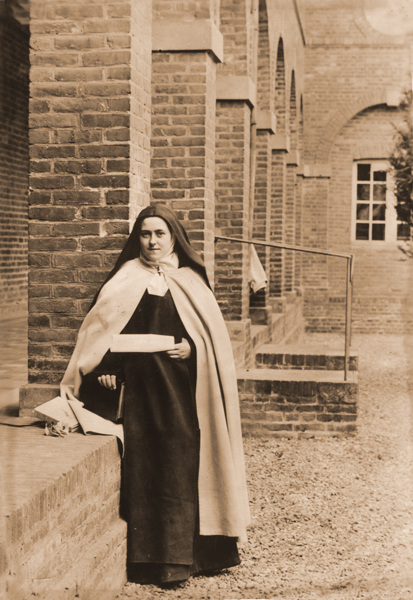
The fourth suffering Therese encountered at her entry to Carmel was physical. It was certainly the least painful and was mitigated to some extent as shall be seen. The Carmelite diet is something that requires some adjustment to all who enter. The postulant must get used to not eating meat and to eating more dried beans, fish and vegetables than she was probably accustomed to eat.
For Sr. Therese, the problem was not just the Carmelite diet, but also how this youngest member of the community was sometimes served. Two sources speak of this: her family and her letters. Until the 1970s when her letters were published, what her family thought and revealed was all that was known. When they saw her each week in the parlor looking pale and worn, they were very concerned about the food she was eating. Celine said: “I can still see her with her pale face, but so happy because she was able to suffer something for God.” And again: “Since she was seen to be so patient, always uncomplaining, this child was served all the leftovers of the meals, instead of being given especially strengthening food, which was what she needed. It frequently happened that she had nothing on her plate but a few herring heads, or reheated leftovers that had been standing around for days.” Here Celine is only repeating statements she had heard in the parlor from her older sisters because she was not yet in Carmel herself. There is some truth in what she said. There is no evidence that Sr. Therese was given a regular special diet because of her age. It is true that it is the custom in Carmel to supplement the diet of those who have not yet reached the age to fast on fast days. Another thing that cannot be passed over is the fact that there was no refrigeration in those days. Whether the Carmelites even had an ice box, and if the leftovers were kept there, is not known. It seems very doubtful. So, leftovers sometimes could be bad and “should have been thrown in the bin.” It is possible that a thoughtless server could make an “honest” mistake, thinking that this food could not be served to the sick or older sisters, but would be alright for the youngest who must have a good appetite. Many sisters, in the process of beatification, testify that she was almost invariably given leftovers that no one else would eat. Sr. Therese may have embraced this treatment feeling, that indeed, here, she was being allowed to make some real sacrifice, while on other days she felt spoiled. Later, in a letter to Celine, in August of 1894, she speaks of her “iron health” which undoubtedly, until it broke down, she employed to generously give herself to all sorts of hardships as shall be seen later. On the other hand, it seems doubtful that the meals Celine described could have been served very often without her Mistress of Novices’ or the Prioress’ knowledge and the former, especially, was concerned about Sr. Therese’s stomach aches. Only when she was in her last illness was St. Therese obliged to say which foods caused her digestive problems. She admitted then that dried beans and other foods had always been the cause. The Carmelite diet itself, then, did not always agree with her constitution. To make it worse, when Sr. Marie of the Sacred Heart was serving the portions, she always gave Sr. Therese a large portion of the beans she herself loved.
St. Therese’s letters, however, provide us with evidence that the food was not always bad. Sr. Therese’s father, the Guerins, and her sisters outside showered the community with donations. The Prioress approved of this and gave her consent for the numerous letters of thanks which Sr. Therese had to write. Every time Mr. Martin went fishing he gave a considerable part of his catch to the monastery. After he became ill, the Guerin family generously assumed responsibility for this gift. Three weeks after she entered, Sr. Therese wrote: “Oh, how good you are to your little queen; scarcely a day passes that she does not receive some gift from you.” And again later: “The postman of the Child Jesus is very kind; I send him kisses and caresses. I drink the wine he gives me with delight and as I do so I reflect that it comes from the cellar of the Child Jesus.” “Happy New Year, my darlingest king; thank you for spoiling us with all the treats you have given us this week and all through the year,” (cakes, baked goods, an avalanche of onions, plums and pears, another time apples and cherries, a carp which Sr. Marie of the Sacred Heart made a sauce for…) “It was marvelous, tasted literally like worldly cuisine… But it does not always take such things to give one an appetite. Not me anyway, I have never eaten so much in my life since I have been in Carmel.”
For her reception of the habit, Mr. Martin sent an artificial melon, which burst to scatter a rain of sweets, and some bottles of champagne. On her sixteenth birthday, her Aunt sent a “splendid packaged spice-cake” for the whole community. St. Therese was still writing the Guerins years later thanking them and saying she hoped she had not forgotten anything. These are a few examples to show a certain balance between the daily mortifications and the feast day treats. Mention should be made of another physical suffering, which, over the span of her life in Carmel, was probably much greater than the diet, and that was the cold. Very little information is to be had on this subject. We know the cold, damp Normandy winters caused her much suffering in the building without any central heating.
We know this because at the end of her life she one day admitted: “I have suffered so much from the cold that I thought I would die of it.” Her generosity is seen by the ways she mortified herself with regard to the cold. The open cloisters they had could catch all the cold, damp winds, but witnesses testified that she was never seen to hunch her shoulders against it, or to rub her hands together to warm them. One Sunday or feast day at recreation all the Sisters had their hands under their scapulars, this being the normal custom on a day when work was not being done. All, that is, except Sr. Therese, who had her hands separated and lying flat on top of her scapular. Sister Marie of the Sacred Heart noticed this, and, as it was a cold day, made her a sign to put them under her scapular. Sr. Therese’s only reply was a mischievous smile. Being cold like everyone else, she wanted to profit from it by mortifying herself – though this example shows a bit of singularity! On another occasion, her novice, Sr. Marie of the Trinity, took her alpargates (Carmelite sandals), off the warming oven where they had been put to dry and she put them on quickly with the obvious pleasure of having them nice and warm. St. Therese, noticing this, said to her: “If I had permitted myself to do that, I would have thought myself to be very unmortified.” She thus heroically added to the suffering she was experiencing from the cold by not giving in to nature.
In our last newsletter we shared the news of a First Profession on March 19th, feast of Our Good Father St. Joseph. This time we are happy to announce another First Profession for this year, that of Sr. Margaret of the Heart of Jesus, which took place on the Carmelite feast of the Solemnity of St. Joseph, (third Wednesday after Easter) April 22. Our gratitude to this great Saint knows no bounds! Not to be outdone, St. Therese of the Child Jesus sent us a very special gift earlier in the month of April, on the anniversary of her own entrance into Carmel. On Thursday, April 9th, which also fell during the beautiful Octave of Easter, we joyfully received another new postulant! We are most grateful to have our new wing finally in place to accommodate more vocations.
On that note, our dry-wells have been installed, and the final grading is all but finished around the building site. Landscaping is still in progress, so our promised color pictures will have to wait for the July/August newsletter. The new courtyard gate is in place, and everything is starting to look tidy and finished. We are planning a “Rock Party!” A Sister will drive the little tractor and its trailer, and the rest of us will fill the trailer with all the rocks exposed by the grading (we have very rocky soil). The garden is doing well despite the hoop house disaster. A new makeshift tunnel has been created using poles, flexible branches, and leftover plastic from the hoop house. This contraption will give some crops an extended season, assuming it holds up!
We wish all our readers a blessed month of the Sacred Heart, and we remain united in prayer with you for the intentions of the SSPX as we approach the long-awaited episcopal consecrations. Your own intentions remain also in our grateful prayers.
Yours in the Sacred and Immaculate Hearts,
The Carmelites